Birdwatching Safari in Uganda 2026

With the recent stabilization of local tourism infrastructure and the opening of upgraded canopy walkways, 2026 offers unprecedented access to remote habitats. Whether you are chasing the elusive Shoebill or aiming to break the 500-species barrier on a single trip, Uganda delivers.
Let’s unpack the where, the what, and the how of planning your Birdwatching Safari in Uganda 2026: Top Hotspots, Rare Species & Expert Tips.
Hotspot #1: Mabamba Swamp – The Quest for the Dinosaur Bird
Located on the fringes of Lake Victoria, accessible via a short canoe ride from Entebbe, Mabamba is arguably the most reliable place on earth to see the Shoebill.
Why go here:
-
The Star: The Shoebill. Standing 4 feet tall with a shoe-shaped bill, it looks like a prehistoric relic.
-
Other Gems: Blue-headed Coucal, Papyrus Gonolek, and the striking Malachite Kingfisher.
-
Pro Tip: Go with an experienced guide who knows the swamp channels. The Shoebill doesn’t move much; you need a paddler who knows where it “parked” this morning.
Hotspot #2: Bwindi Impenetrable National Park
Most people come to Bwindi for gorillas. Birders come for the Albertine Rift endemics.
The 2026 Advantage:
Recent trail maintenance has opened up the Ruhija sector specifically for birders. This is non-negotiable for any serious Birdwatching Safari in Uganda 2026: Top Hotspots, Rare Species & Expert Tips.
Must-Sees:
-
African Green Broadbill: The holy grail of Ugandan birds. Difficult, but possible with local knowledge.
-
Regal Sunbird: Exactly as the name suggests.
-
Strange-Weaver: Bizarre, beautiful, and highly localized.
Expert Tip: Altitude is your enemy here. Acclimatize for a day before attempting the high-altitude trails.
Hotspot #3: Murchison Falls National Park
Savannah birding at its absolute best. This is where you get the “classic” African safari birds without the crowds of the Masai Mara.
Why Murchison dominates:
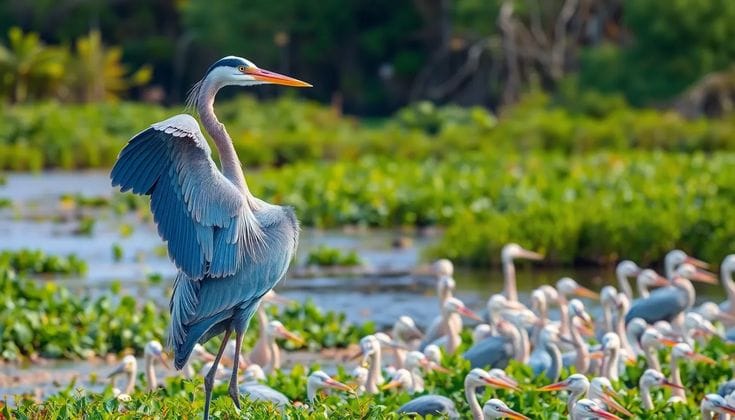
The boat trip to the base of the falls is a birder’s paradise. You aren’t just looking for crocodiles; you are scanning the banks for roosting Pel’s Fishing Owls and the massive Goliath Heron.
Target Species:
-
Shoebill (also present here, though harder than Mabamba)
-
Abyssinian Ground Hornbill (stomping through the grasslands)
-
Denham’s Bustard (rare, but present)
The “Shoestring” Hotspot: Entebbe Botanical Gardens
Don’t skip your layover. You can tick 60+ species before your luggage even arrives at the hotel. The gardens are a microcosm of Uganda’s diversity. Great Blue Turacos bounce through the trees here like pigeons in New York.
The “Big 6” Rare Species to Target
No Birdwatching Safari in Uganda 2026: Top Hotspots, Rare Species & Expert Tips would be complete without a hit-list. Here are the trophies:
-
Shoebill: The ultimate prize. Ancient, statuesque, and vulnerable.
-
Green-breasted Pitta: The skulker of Kibale Forest. You will likely hear it; seeing it requires luck.
-
Shelley’s Crimsonwing: Extremely rare and sought after. Found in the Rugezi Swamp area.
-
African Green Broadbill: Only in the Albertine Rift montane forests.
-
Standard-winged Nightjar: Wait for sunset at the right grassland and watch the males display with incredible wing streamers.
-
Pel’s Fishing Owl: The largest African owl. Requires a night boat trip.
Expert Tips for the 2026 Season
Based on feedback from guides in Kampala and field reports from January 2026, here is how to optimize your trip:
1. Timing is Everything
November to March is peak for migratory birds from Europe and North Africa. However, for resident breeding plumage and dry trails, June to August is prime time for a Birdwatching Safari in Uganda 2026: Top Hotspots, Rare Species & Expert Tips.
2. Gear Up
-
Binoculars: Don’t cheap out here. 8×42 is the gold standard for forest birding.
-
Camera: 2026 travelers are loving mirrorless cameras (Sony A1, Canon R5) with silent shutters—crucial for not spooking the birds.
-
App: Download the Birds of Uganda eBird pack before you leave Wifi.
3. The Guide Factor
You need a specialist. A general safari guide knows where the lions are; a bird guide knows where the Wahlberg’s Honeybird is hiding. Hiring a dedicated bird guide through the Uganda Bird Guides Club is worth every shilling.
4. Sound Recording
Consider bringing a small recording device. Many forest birds are heard far more than they are seen. Recording the call helps with identification later and makes for a great digital souvenir.
Sample Itinerary: 12 Days of Birding Excellence
Day 1-2: Entebbe (Botanical Gardens & Mabamba Swamp for Shoebill)
Day 3-4: Mabira Forest (Forest specialists)
Day 5-7: Kibale Forest / Bigodi Wetland (Pittas & Prinia’s)
Day 8-9: Bwindi (Albertine Rift Endemics)
Day 10-12: Murchison Falls (Savannah specials & Pel’s Fishing Owl)
Note: Internal flights between Bwindi and Murchison are now more reliable in 2026, saving you two full days of driving.
Conservation: Birding With Purpose
When you book a Birdwatching Safari in Uganda 2026: Top Hotspots, Rare Species & Expert Tips, you are actively funding conservation. Park entrance fees go directly to ridding protected areas of snares and employing local community members as guides. The presence of birders discourages poaching; a Shoebill with a camera pointed at it is worth infinitely more alive than dead.
The Verdict
Uganda offers a density of bird species that rivals anywhere else on the planet. With over 1,070 species recorded in a country roughly the size of Oregon, the odds are stacked massively in your favor.
Whether you are a lister chasing your 4,000th species or a casual traveler who simply wants to see something beautiful before breakfast, a Birdwatching Safari in Uganda 2026: Top Hotspots, Rare Species & Expert Tips delivers a richness that big game safaris simply cannot replicate.
It’s quiet. It’s challenging. It’s deeply rewarding.
Are you ready to make the Pearl of Africa your birding playground this year?